Epic Antarctica: Crossing the 7th Continent
Welcome to Aurora Expeditions’ **Epic Antarctica: Crossing the 7th Continent** expedition. Calling all pioneers, history buffs and adventure lovers for an epic
Comodidades da Viagem
Welcome to Aurora Expeditions’ Epic Antarctica: Crossing the 7th Continent expedition.
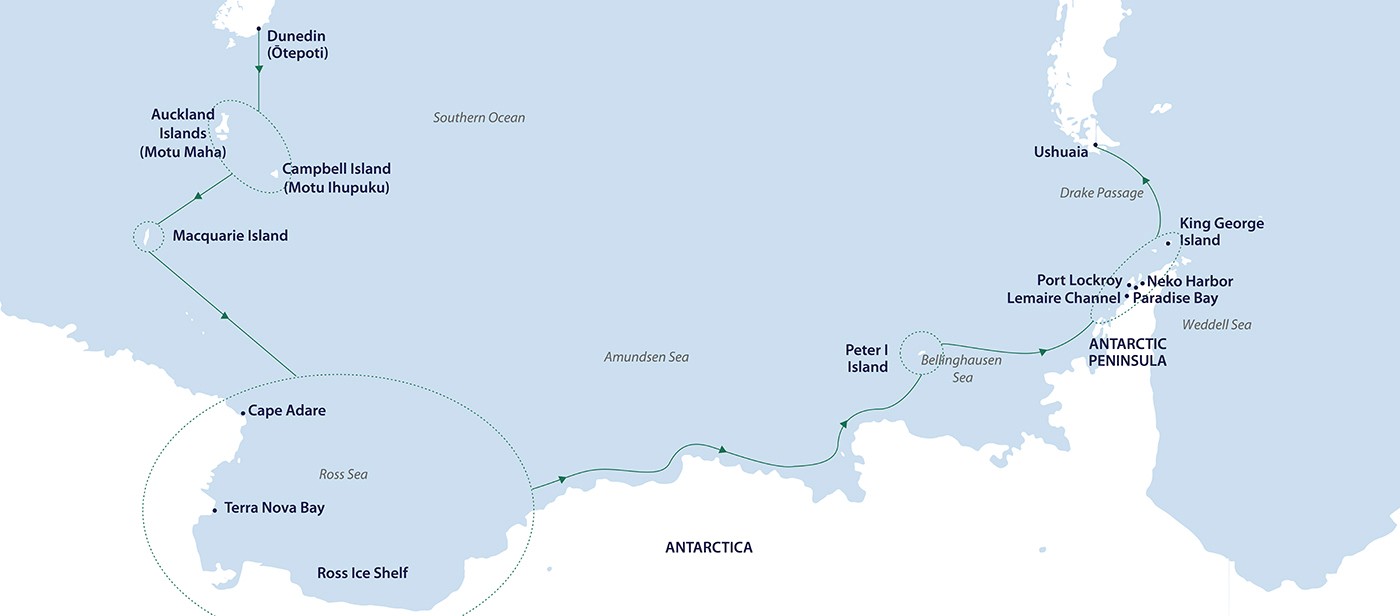
Calling all pioneers, history buffs and adventure lovers for an epic adventure across the southern seas. Follow in the footsteps of explorers such as Scott, Ross, Amundsen and Shackleton and embark on a journey very few people on this planet have made. Sail beyond the Antarctic Circle, uncover wonders of the Ross Sea, explore the Peninsula and the incredible sights in between! This is a once-in-a-lifetime opportunity to witness the beauty and majesty of this remote and pristine environment.
Day-by-day itinerary
Day 1: Arrive Dunedin
Arrive in Dunedin, where you will be met by a representative of Aurora Expeditions and transferred with your fellow expeditioners to your assigned pre-voyage hotel. If you are already in Dunedin, we ask you to make your way to your hotel. This afternoon, visit the Aurora Expeditions hospitality desk in the lobby to collect your luggage tags. Please clearly label the tags with your name and ship cabin number. Our team will confirm details regarding your embarkation day, answer any questions and provide you with information on where to dine or purchase last minute items. That evening, you may like to indulge in a meal at one of Dunedin’s fine restaurants, or perhaps enjoy a leisurely stroll along the picturesque Otago harbour. Assigned accommodation: Scenic Hotel Dunedin City.
Day 2: Embarkation
This morning, enjoy breakfast and check-out. Please ensure your cabin luggage is fitted with cabin tags clearly labelled with your name and cabin number. By 11.00 am, take your cabin luggage to hotel reception, prior to, or at check-out. Your luggage will be stored and transferred directly to the port for clearance, to be placed in your cabin ahead of your arrival on board. Please keep any valuables or personal items with you throughout the day. Your morning is at leisure to explore Dunedin. Settle into your cabin, where each detail was designed with your comfort in mind. This luxurious vessel is yours to explore! As we throw the lines and set sail, join your expedition team on deck before tucking into a delicious dinner, and toast to the voyage ahead.
Day 3: At Sea
On an expedition such as this, the journey is as significant as the destination. Sea days are a wonderful opportunity to relax, meet your fellow travellers and learn about the history, environment and local wildlife in this fascinating corner of the globe. As you acclimatise to life on board, your expedition team is available to answer any questions you may have and offer pro-tips on photography and birdwatching. With decades of collective experience in the region, they love to share their expertise and enthusiasm with fellow travellers. Join them in the lecture room for entertaining talks and presentations to enrich your understanding of the wildlife, landscapes and historic sites we hope to encounter. You may like to pamper yourself with a sauna, a visit to the Wellness Centre, or work out at the onboard gym. While away the hours spotting seabirds on deck, curl up with a book in our well-equipped polar library, or chat with your fellow expeditioners at the bar.
Day 4: New Zealand’s Subantarctic Islands
First visited by Māori navigators centuries ago, these islands are of great significance to Ngāi Tahu, the indigenous peoples of New Zealand’s South Island. Their natural beauty and astonishing biodiversity have now been recognised globally, but few have had the privilege to visit these far-flung shores, which are now yours to explore. Auckland Islands (Maungahuka / Motu Maha) Born of fire, scoured by ancient glaciers and shaped by the fierce hand of the Southern Ocean, there is an exquisite ruggedness to this group of weather-worn islands. This apparent bleakness belies the extraordinary abundance of life that thrives here. Roughly half of the world’s yellow-eyed penguins (hoiho), most of the world’s white-capped mollymawks, and the entire population of Auckland Islands wandering albatross find shelter on these shores. Embrace the spirit of exploration as your expedition team designs your voyage from day to day, bringing decades of experience to selecting ideal sites based on the prevailing conditions and wildlife opportunities. Some places we may visit include: Sandy Bay, Carnley Harbour (Erlangen Clearing), Victoria Passage.
Day 5: New Zealand’s Subantarctic Islands (continued)
Continue exploring the Subantarctic Islands.
Day 6: New Zealand’s Subantarctic Islands (continued)
Campbell Island (Motu Ihupuku) Wind and weather permitting, we will Zodiac cruise sheltered harbours and coves in search of Campbell Island snipes and teals, yellow-eyed penguins (hoiho), and New Zealand (Hooker’s) sea lions (whakahao). We hope to land at Beeman Cove, Perseverance Harbour, where an old meteorological station stands vigil on the windswept shoreline. Follow a boardwalk through tussock and upland tundra, then enter an otherworldly landscape where large-leaved megaherbs abound. Wonder at the Ross Lily, Campbell Island Daisy and Campbell Island carrot, whose brilliant flowers would look more at home in the tropics than these southern climes. Continue towards the nesting grounds of majestic southern royal albatross, whose wingspans can exceed three metres (10 feet).
Day 7: At Sea
As Campbell Island slips over the horizon, keep watch for Campbell, Salvins and white-capped albatross, which may follow the ship to bid us farewell as we continue south. Join your expedition team in the lecture room to hear about the fascinating human history of Macquarie Island, and how to identify the unique and charismatic creatures we hope to see in the coming days.
Day 8: Macquarie Island
“Penguins were in thousands on the uprising cliffs, and from rookeries near and far came an incessant din . . . seabirds of many varieties gave warning of our near approach to their nests” Douglas Mawson, 1911. As they sailed towards Antarctica, Mawson and his men encountered ‘an exquisite scene’. Macquarie Island (known affectionately as Macca) rises steeply from the Southern Ocean in a series of emerald summits: a beautifully fierce, elemental landscape teeming with life. Keep your binoculars handy because this subantarctic refuge is home to 3.5 million breeding seabirds, including no less than four species of penguin! Alongside boisterous colonies of tuxedoed kings, charming gentoos, robust rockhoppers and endemic royal penguins, you’ll find three types of fur seals and a large proportion of the world’s elephant seals. Layer up and head out on deck to experience the sound, sight (and smell!) as you approach one of the largest concentrations of life in the Southern Ocean. Remember to keep an eye out for Macca’s kelp forests—these remarkable underwater ecosystems are quite mesmerising as their fronds sway back and forth on the water’s surface. In addition to being a globally recognised and protected wildlife refuge, Macquarie Island played an important role in Antarctic history. It was here, in 1911, that five men disembarked Mawson’s Aurora and established a radio relay station which would transmit the first communication from Antarctica to the outside world.
Day 9: Macquarie Island (continued)
Continue exploring Macquarie Island.
Day 10: At Sea
As Macquarie Island slips over the horizon, keep watch for wandering, grey-headed, black-browed and light-mantled albatross, which may follow the ship to bid you farewell as you continue south. Close observers may notice a subtle change in the character of the sea as we cross the Antarctic Convergence. Beyond this belt where the waters of the north and south mix, the sea surface temperature drops by about 4°C (39°F), signalling our entry into the Antarctic. This transition zone is known for its nutrient-rich waters, so keep watch for porpoising penguins, flocks of fluttering Antarctic petrels, or perhaps the more solitary snow petrel. You’re not far from the Antarctic Circle, so your first iceberg can’t be far away! Sea days are a great opportunity for some R & R as you digest your subantarctic experiences and prepare for the next phase of your voyage.
Day 11: At Sea
Continue sailing towards the Ross Sea.
Day 12: At Sea
Relax and unwind your way, perhaps meeting newfound friends at the bar, treating yourself to a sauna, or editing some images in the comfort of your cabin. And join your expedition team in the lecture room for presentations on the charismatic wildlife and extraordinary adventures that took place along the epic Antarctic coastline you are about to experience.
Day 13: Ross Sea
It’s almost impossible to describe the feeling of arriving in this storied, ice-bound sector of Antarctica. Stepping outside and taking a deep breath of some of the most fresh, crisp air on earth is an experience to cherish forever. The Ross Sea region is a globally significant wildlife sanctuary. Its nutrient-rich waters support an astonishing array of uniquely adapted Antarctic species, including Ross Sea orcas, Antarctic petrels and South Pacific Weddell seals. It is also home to Antarctica’s largest Adélie penguin colony, and many of the largest emperor penguin colonies. The unique biodiversity of the Ross Sea has been protected within the world’s largest marine protected area since 2016. The human heritage of the Ross Sea coast is equally impressive. Since James Clark Ross discovered the region in 1841, countless expeditions have built base camps on scattered ice-free slivers of land, using them as staging posts for bold forays across the polar plateau. Many of them departed in a hurry, leaving artefacts, scientific equipment and sometimes entire huts behind. Today these sites are preserved as open-air museums and protected under the Antarctic Treaty System.
Day 14: Ross Sea (continued)
Embrace the spirit of exploration as your expedition team designs your voyage from day to day. Some places we may visit include: Ross Ice Shelf, Franklin Island, McMurdo Sound.
Day 15: Ross Sea (continued)
Continue exploring the Ross Sea region. Possible visits: Cape Washington, Terra Nova Bay.
Day 16: Ross Sea (continued)
Possible visit: Cape Hallett.
Day 17: Ross Sea (continued)
Possible visit: Cape Adare.
Day 18: Ross Sea (continued)
Final day in the Ross Sea region.
Day 19: Expedition Cruising, Cross the International Date Line
As you reach the halfway mark of your voyage, these days at sea offer time and space to reflect on the emotions and special moments you’ve experienced so far. You may like to make some notes in a journal, reminisce with newfound friends at the bar or start editing a backlog of amazing photos. For the next week, find your rhythm and settle into life at sea. Your expedition team will offer a daily program of educational activities, entertainment and citizen science programs.
Day 20: Expedition Cruising
Continue sailing west past the Amundsen and Bellingshausen Seas.
Day 21: Expedition Cruising
Cross international date line and continue towards Antarctic Peninsula.
Day 22: Expedition Cruising
Continue sailing.
Day 23: Expedition Cruising
Continue sailing.
Day 24: Expedition Cruising
Continue sailing.
Day 25: Expedition Cruising
Continue sailing.
Day 26: Expedition Cruising
Continue sailing towards the Antarctic Peninsula.
Day 27: Antarctic Peninsula
While on the Peninsula we generally make landings or Zodiac excursions twice a day. Rug up and join a Zodiac cruise to view spectacular ice cliffs or explore grounded icebergs, keeping an eye out for whales, seals and penguins. Zodiacs will also transport you from the ship to land, where you can visit penguin rookeries, discover historic sites and explore some of our favourite spots along the Peninsula. While ashore we aim to stretch our legs, wandering along pebbly beaches or perhaps up snow-covered ridgelines to vantage points.
Day 28: Antarctic Peninsula (continued)
Continue exploring the Antarctic Peninsula.
Day 29: Antarctic Peninsula (continued)
Continue exploring the Antarctic Peninsula.
Day 30: Antarctic Peninsula (continued)
Continue exploring the Antarctic Peninsula.
Day 31: Antarctic Peninsula (continued)
Last day on the Antarctic Peninsula.
Day 32: At Sea (South Shetland Islands)
The South Shetland Islands is a volcanic island group around a day’s sail from the Antarctic Peninsula. We aim to land or Zodiac cruise at one of the many appealing coves, bays and beaches, with the opportunity to see chinstrap and gentoo penguin colonies, fur and elephant seals, and the historic remnants of the sealing and whaling age. In the afternoon, begin your transit north across the Drake Passage.
Day 33: At Sea (Drake Passage)
Continue crossing the Drake Passage. Take some time to reflect on the experiences of the past few weeks. Perhaps you’d like to organise your photos, jot some more notes in your journal or simply relax and soak up the ambiance on board as you farewell your travel mates . . . until next time!
Day 34: Disembark in Ushuaia
During the early morning, we cruise up the Beagle Channel, before quietly slipping into dock in Ushuaia, where we will be free to disembark around 8.00 am. Farewell your expedition team and fellow passengers as we all continue our onward journeys. Upon disembarkation, transportation to the hotel will be arranged for guests who have booked accommodations through Aurora or for those staying in downtown areas. Expeditioners departing on flights prior to 12:30 pm will be directly transferred to Ushuaia Airport, those with flights after 12:30 pm will have the opportunity to explore Ushuaia before an afternoon airport transfer.
O que está Incluído
All airport transfers mentioned in the itinerary.
One night’s hotel accommodation including breakfast, in Dunedin on Day 1.
Onboard accommodation during voyage, including daily cabin service.
All meals, snacks, tea, coffee, soft drinks and juices during voyage.
Beer and house wine with dinner.
Captain’s Farewell reception including four-course dinner, house cocktails, house beer and wine, non-alcoholic beverages.
All shore excursions and Zodiac cruises.
Educational lectures and guiding services provided by Expedition Team.
Complimentary access to onboard expedition doctor and medical clinic (initial consultation).
One 3-in-1 waterproof, polar expedition jacket.
Complimentary use of Muck Boots during the voyage.
Comprehensive pre-departure information.
Port surcharges, permits and landing fees.
Wi-Fi*.
O que não está Incluído
International or domestic flights – unless specified in the itinerary.
Transfers – unless specified in the itinerary.
Airport arrival or departure taxes.
Passport, visa, reciprocity and vaccination fees and charges.
Travel insurance or emergency evacuation charges.
Hotel accommodation and meals – unless specified in the itinerary.
Optional excursions and optional activity surcharges.
All items of a personal nature, including but not limited to alcoholic beverages (outside of dinner service), gratuities, laundry services, personal clothing, medical expenses or phone charges.
Tipos de Cabines
| Tipo de Cabine | Disponibilidade |
|---|---|
Aurora Stateroom Triple | Disponível |
Aurora Stateroom Twin | Disponível |
Balcony Stateroom A | Disponível |
Balcony Stateroom B | Disponível |
Balcony Stateroom C | Disponível |
Balcony Stateroom Category A | Disponível |
Balcony Stateroom Category A - Solo | Disponível |
Balcony Stateroom Category B | Disponível |
Balcony Stateroom Category B - Solo | Disponível |
Balcony Stateroom Category C | Disponível |
Balcony Stateroom Superior | Disponível |
Captain's Suite | Disponível |
Junior Suite | Disponível |
Faça login para ver os preços das cabines
EntrarAções
Visão Geral da Viagem
Duração
33 dias
Modo de Viagem
sail
Data de Partida
Jan 7, 2027
Data de Retorno
Feb 8, 2027
Porto de Partida
Porto de Retorno
Atividades
Zodiac Cruising
Antarctica Landing & Hiking
Photography Workshop
Polar Plunge
Sea Kayaking
Greg Mortimer
Passenger capacity and vessel specifications are awaiting source verification. Please confirm the configuration for your voyage.
Saiba MaisVida Selvagem Que Você Pode Ver